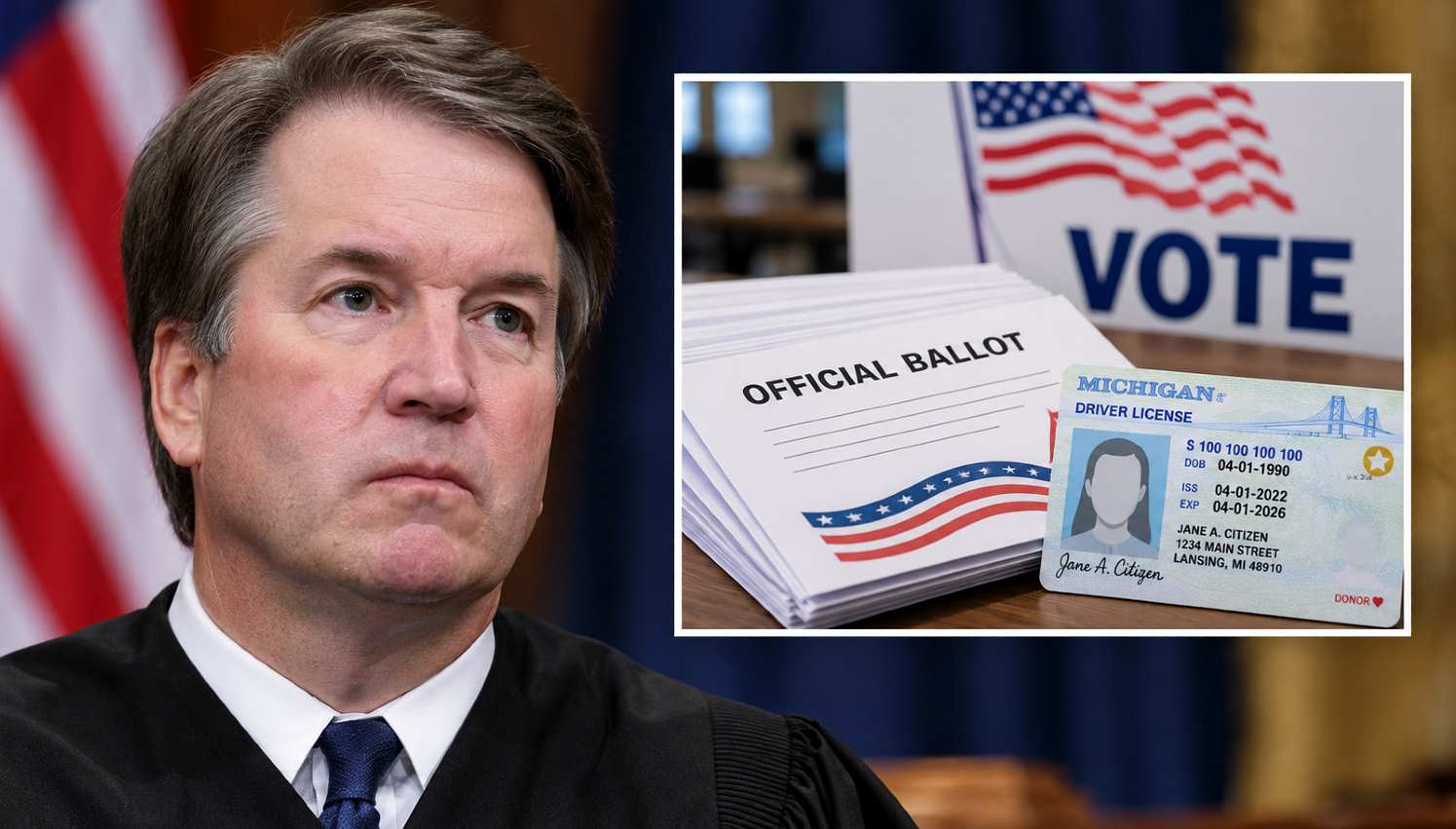
Supreme Court Justice Brett Kavanaugh delivered a consequential election decision Thursday as Michigan officials approached a deadline for finalizing the state’s November ballot.
The emergency dispute put the Trump-appointed justice in the position of deciding whether the nation’s highest court should intervene immediately in a fight over proposed voting requirements.
Supporters of a proposed constitutional amendment had asked the Supreme Court to act before Michigan’s ballot process moved beyond their reach.
The case centered not on whether states may generally impose citizenship-verification requirements, but on whether this particular proposal had satisfied Michigan’s requirements to reach voters this fall.
Kavanaugh denied an emergency application from Americans for Citizen Voting—Michigan and voter Fred Smith seeking an order requiring state officials to place their proof-of-citizenship proposal on the November 3 ballot.
The justice issued the denial himself rather than referring the application to the full Supreme Court, and the brief order did not explain his reasoning, as is common with emergency applications.
Kavanaugh handles emergency matters arising from the Sixth Circuit, which includes Michigan, although individual justices have the option of referring such requests to the full court.
The proposed amendment would require proof of United States citizenship to vote in Michigan elections, adding a verification requirement to the state’s existing prohibition against noncitizen voting.
Supporters said they submitted approximately 709,000 signatures in March, substantially more than the 446,198 valid signatures they said were needed to qualify the proposal for the ballot.
The Michigan Board of State Canvassers ultimately deadlocked over whether the petition contained enough valid signatures, leaving the proposal without certification as the deadline for finalizing the November ballot approached.
Americans for Citizen Voting—Michigan then sought relief from the Michigan Supreme Court, arguing that state officials had improperly prevented voters from considering an amendment that supporters believed had satisfied the requirements.
When the state Supreme Court did not provide the requested relief before the looming ballot deadline, the organization turned to the U.S. Supreme Court and asked Kavanaugh to intervene.
Attorneys for the applicants argued that Michigan’s handling of the petition violated their constitutional rights to due process and equal protection and contended that immediate federal intervention was necessary because the deadline was approaching.
Their application said the Board of State Canvassers had effectively disenfranchised more than 700,000 Michigan residents who signed petitions supporting placement of the proposal before voters.
Michigan officials urged Kavanaugh to reject the request, arguing that the challengers were asking the U.S. Supreme Court to intervene in an unresolved state administrative and judicial process under extraordinary circumstances.
Representing Democratic Secretary of State Jocelyn Benson and other state officials, Michigan’s filing described the application as “highly unusual” and argued that the state courts were better positioned to conduct a comprehensive review of the dispute.
“The Court should decline to put its thumb on the scale in this manner, particularly in the case of a state administrative proceeding where a state court can provide more fulsome and comprehensive review,” Michigan argued.
Federal and Michigan law already prohibit noncitizens from voting in federal and state elections, while the Michigan Department of State has said it has found no evidence that noncitizen voting occurs on a large scale.
Michigan Attorney General Dana Nessel announced charges in August against five noncitizens accused of voting in the November 2024 general election, along with a U.S. citizen accused of registering a noncitizen spouse to vote.
Those prosecutions provided a recent example of alleged illegal voting in the state, although they did not establish the widespread noncitizen voting sometimes alleged in political debates over election security, MS NOW reported.
Kavanaugh’s order did not resolve the broader constitutional or political debate over requiring documentary proof of citizenship, nor did it establish a nationwide precedent prohibiting such requirements.