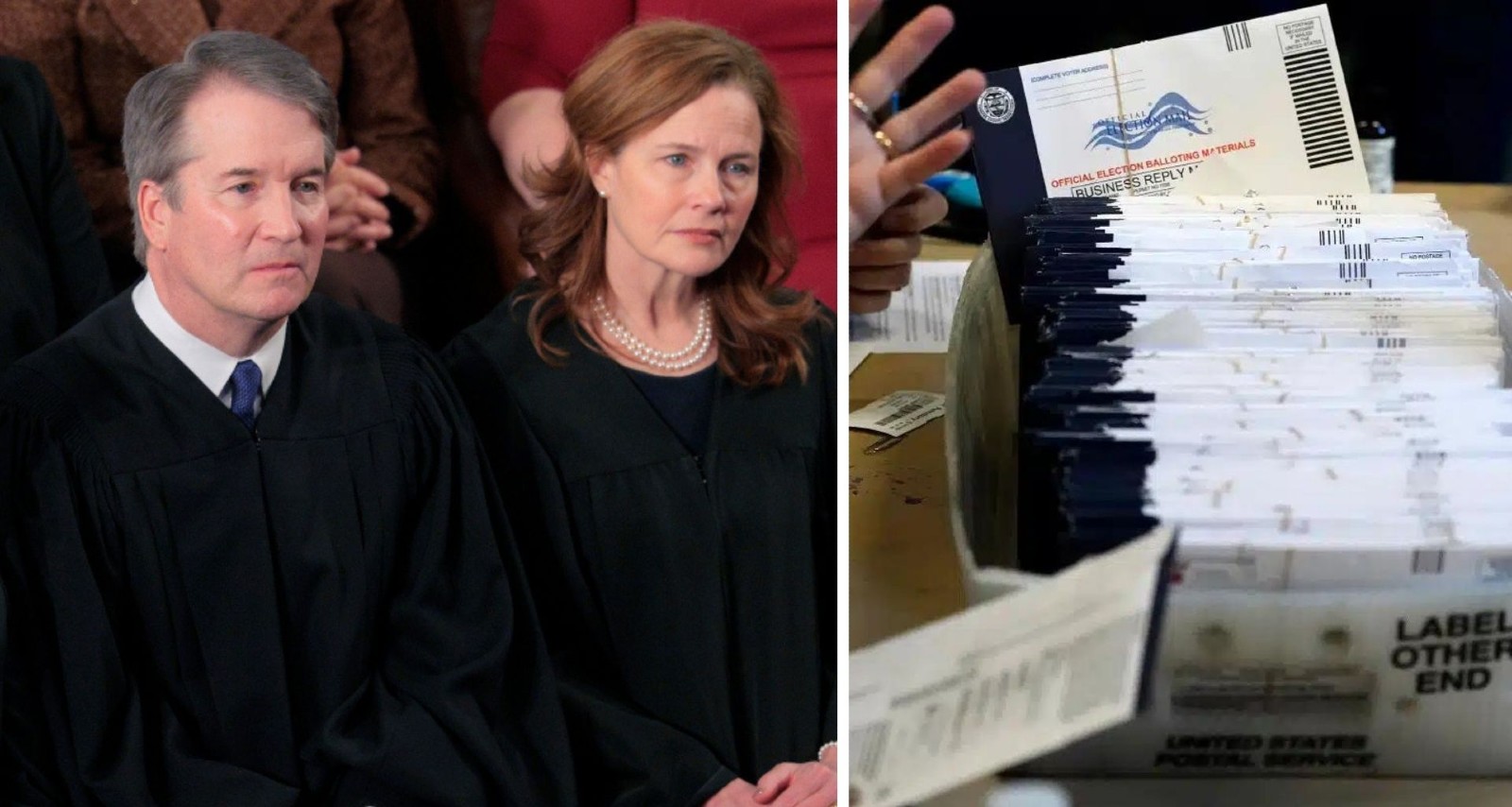
The administration on Thursday asked the justices to allow the U.S. Postal Service to enforce a new rule requiring states to provide lists of approved mail-ballot recipients and use unique barcodes on outgoing and return ballot envelopes. Under the rule, USPS would deliver ballots only to voters appearing on state-provided eligibility lists. ([Reuters][1])
The latest filing follows a rapidly changing series of court rulings over Trump’s March executive order on election administration.
U.S. District Judge Indira Talwani in Boston initially blocked implementation of portions of the order in Democratic-led states and later issued a broader injunction preventing the Postal Service from carrying out the requirements nationwide.
The Supreme Court overturned the earlier state-focused injunction in August, concluding that the challenge had been brought before the Postal Service finalized the rule spelling out how Trump’s directive would be implemented. The ruling was procedural and did not resolve whether the executive order itself is constitutional. ([Reuters][1])
Talwani subsequently lifted her earlier nationwide injunction in response to the Supreme Court decision.
But the legal opening for the administration proved short-lived.
After USPS finalized its regulations, Democratic-led states and voting-rights groups returned to court with renewed challenges. Talwani issued another temporary order on Aug. 27 blocking key portions of the finalized Postal Service rule while the litigation proceeds. ([Justia Dockets & Filings][2])
That means the new mail-ballot requirements are currently blocked despite the administration’s earlier Supreme Court victory.
The Justice Department appealed Talwani’s latest ruling to the 1st U.S. Circuit Court of Appeals and, before that court had ruled, filed an emergency request asking the Supreme Court to intervene again. ([Reuters][1])
The administration argues that the Postal Service has legal authority to establish the requirements and maintains that states would continue determining which voters are eligible to cast ballots by mail.
Government lawyers have also rejected warnings that implementing the rule close to Election Day would cause widespread disruption, saying USPS can work with state officials to meet the new requirements. ([Reuters][1])
Opponents contend that the executive branch and Postal Service are attempting to impose federal controls on an election process largely administered by states.
The lawsuits argue that USPS lacks authority to refuse to handle otherwise valid ballots based on federal requirements that Congress did not enact.
Talwani has previously expressed substantial doubts about the policy’s legality, concluding in an earlier ruling that challengers were likely to succeed on claims that the administration had exceeded its authority. ([Justia Dockets & Filings][3])
The timing has added urgency to the dispute.
North Carolina began sending mail ballots Friday, becoming the first state to do so for the Nov. 3 election, while other states are preparing to follow throughout September. ([AP News][4])
Many election officials have told the courts that ballot envelopes have already been printed and election systems configured, leaving little time to implement new federal requirements.
The online portal that states would use to upload their voter lists also was not yet fully operational as of this week, although USPS said it continued working on the system. ([Reuters][1])
The finalized rule stems from Trump’s March executive order, which directed USPS to establish standards governing mail-ballot envelopes and require states to submit lists identifying voters authorized to receive ballots through the mail.
Trump has long argued that mail voting requires stronger safeguards and has made election administration a major policy focus of his second term.
Opponents dispute his characterization of mail voting as particularly vulnerable to fraud and argue that the new requirements could result in eligible voters failing to receive ballots because of administrative or database errors.
A separate controversy emerged this week after an anonymous Postal Service whistleblower alleged that the agency had rushed development of the computer system needed to implement the rule and that technical problems could interfere with ballot distribution. USPS has said it is reviewing those allegations and continuing to refine the system. ([AP News][5])
The litigation now leaves states facing significant uncertainty over which rules will govern mail voting in November.
The Supreme Court’s previous ruling removed one legal obstacle to Trump’s executive order but explicitly left the underlying dispute open for renewed litigation once USPS took concrete action.
That has now happened.
With a finalized rule in place and a new injunction blocking it, the administration is again asking the Supreme Court to intervene — this time in a dispute that more directly presents questions about the federal government’s authority over the handling of mail ballots.
For now, Talwani’s latest order remains in effect and the Postal Service cannot enforce the challenged provisions while the courts consider the administration’s appeal. ([Reuters][1])