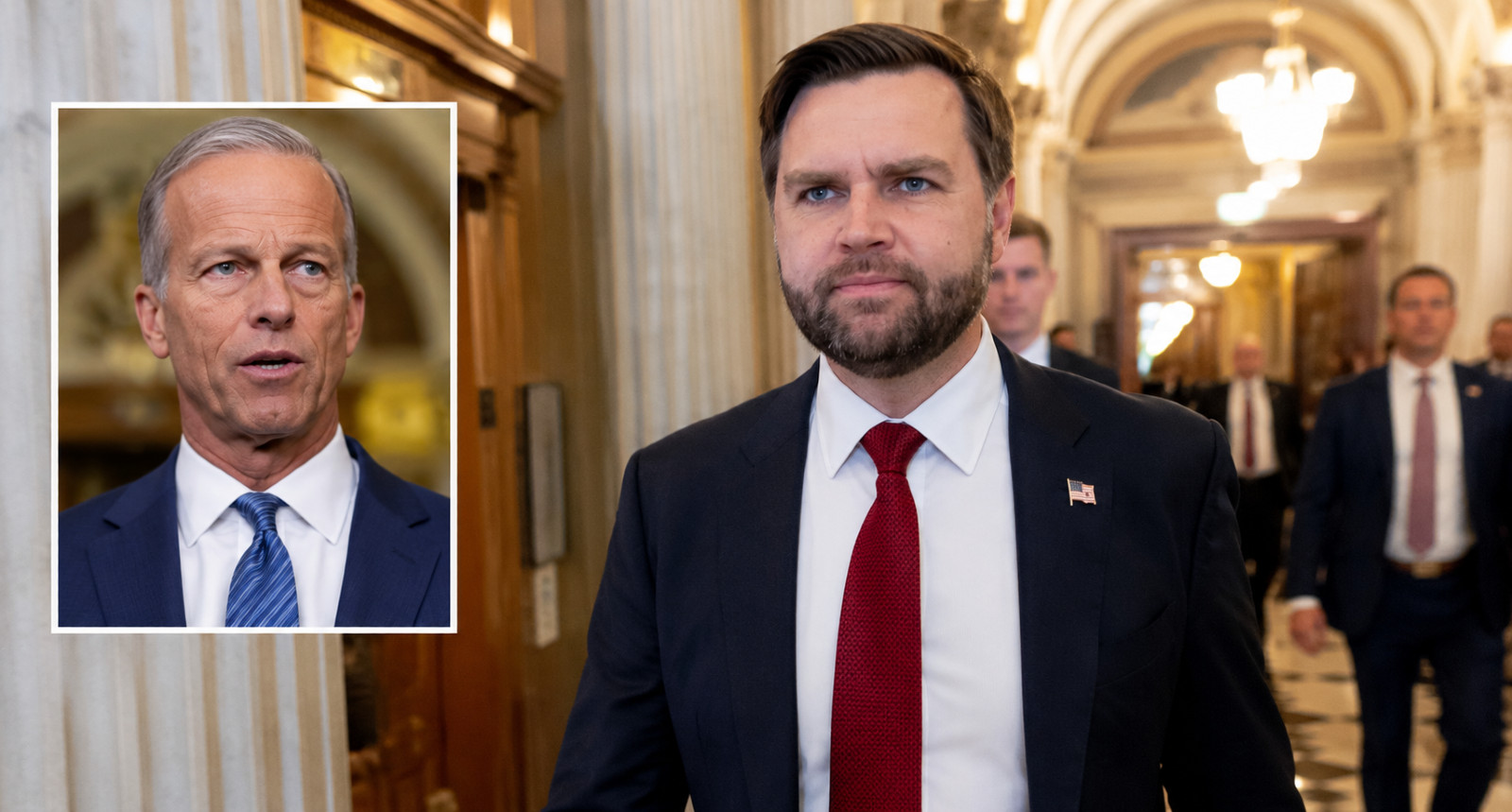
Speaking on Newsmax’s “Carl Higbie FRONTLINE” recently, Vance said the White House has examined whether he could use his constitutional position as president of the Senate to preside over the chamber and issue a ruling contrary to the advice of the Senate parliamentarian.
“So, we’ve actually looked into this. As the president of the Senate under the U.S. Constitution, there are things that we can do,” Vance said.
“We can take over the Senate chair. I can occupy the chair. We can overrule the parliamentarian. Those things are very possible.”
The parliamentarian advises the Senate’s presiding officer on the chamber’s rules and precedents but does not independently issue binding rulings.
The presiding officer generally follows that advice when ruling on procedural questions. Senators can then appeal many rulings of the chair, allowing the full Senate to determine whether the decision should stand.
Depending on the procedural question involved, such appeals are often decided by a simple majority, although certain budget-related points of order require a higher threshold.
Vance said the administration’s problem is determining whether enough Republican senators would support such a move.
“The fundamental issue with that is not the 60-vote threshold. It’s the 50-vote threshold,” Vance said. “So if, for example, I took over the Senate chair, and I overruled the parliamentarian, we would need to sustain 50 senators plus me.”
Vance said President Donald Trump, White House officials and congressional Republicans have been discussing whether they could assemble sufficient support.
“Obviously, most Republicans would support it,” Vance said. “But could we get 50? That’s the big question.”
Republicans currently control the Senate, but the SAVE America Act has repeatedly encountered procedural obstacles because most legislation remains subject to the chamber’s 60-vote threshold for ending a filibuster.
The House passed the legislation 218-213 on Feb. 11, with nearly all Republicans supporting it and all but one Democrat opposing it.
The measure would require applicants registering to vote in federal elections to provide documentary proof of U.S. citizenship.
It would also establish a federal photo-identification requirement for voting and direct states to take additional steps to identify and remove noncitizens from their voter rolls.
Supporters argue that the requirements would strengthen election safeguards and public confidence in federal elections.
Republicans have considered several ways of advancing the bill without obtaining 60 votes.
One option involved incorporating election provisions into budget reconciliation legislation, which can generally pass with a simple majority but is subject to strict limits under the Congressional Budget Act and the Senate’s Byrd Rule.
Trump has repeatedly pressed Senate Majority Leader John Thune, R-S.D., and other Republican senators to find a way around the impasse.
He has also advocated eliminating or changing the legislative filibuster to make it possible for Republicans to pass the measure without Democratic votes.
Vance said the principal resistance is coming from a relatively small number of Republicans who want to preserve existing Senate procedures.
“The problem is not the majority of GOP senators,” Vance said. “It’s that you’ve got a few holdouts who just don’t want to do that because they’re so committed to these archaic rules.”
He argued that Republicans who preserve the filibuster are assuming Democrats would do the same if they regain control of the Senate.
Vance pointed to former Sens. Joe Manchin of West Virginia and Kyrsten Sinema of Arizona, who resisted attempts by Democratic leaders during the Biden administration to create exceptions to the filibuster for voting legislation.
Vance argued that their experience illustrated the political pressure lawmakers can face when breaking with party leadership on major procedural fights.
He also predicted Democrats would eventually seek to eliminate the filibuster to advance priorities such as statehood for Washington, D.C., and Puerto Rico, changes affecting the Supreme Court and federal election legislation.
For now, Vance acknowledged that the White House has not secured enough Republican support to carry out the procedural strategy it has examined.
“We need to end the filibuster to save American elections,” Vance told Newsmax. “It’s the smart and also the patriotic thing to do.”