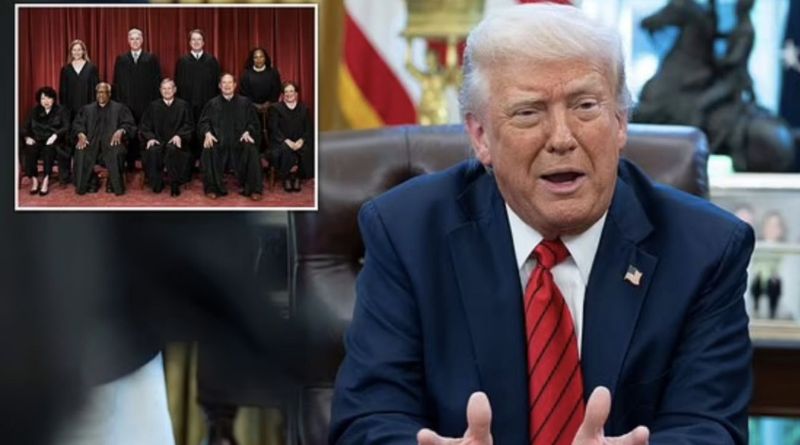
which reflects the author’s opinion.
The unanimous ruling made it clear that courts can look at initial visa denials, but they can’t do anything after the Department of Homeland Security takes away an approved visa.
The decision shows how much power DHS has over visas, and it could affect how immigration laws are enforced, including President Donald Trump’s plans to change immigration laws and deport a lot of people.
Justice Ketanji Brown Jackson, who was appointed by former President Joe Biden, wrote for the court and called the decision “a quintessential grant of discretion” to the DHS.
“Congress did not set specific criteria or conditions that would limit this authority, nor did it say how or when the Secretary must act.” The majority said, “Context reinforces the discretionary nature of §1155,” which is the law that allows the government to cancel approved visa petitions.
“The Secretary ‘may’ revoke a previously approved visa petition ‘at any time’ for what the Secretary thinks is ‘good and sufficient cause,’” the 9-0 ruling said.
Amina Bouarfa, a U.S. citizen, was the plaintiff in the case Bouarfa v. Mayorkas. Her husband’s visa was revoked after the DHS found out that he had been in a fake marriage before, which made him permanently ineligible for legal residency.
The justices focused on a law that only allows judicial review of initial visa denials during oral arguments. This showed that Congress wanted to support the Department of Homeland Security’s power to revoke visas.
Chief Justice John Roberts said that Bouarfa’s husband could apply for a visa again and possibly fight a denial in court. The petitioner’s lawyer, Samir Deger-Sen, said that restarting the process causes families a lot of delays and problems.
Immigration activists said that the decision could make things worse for immigrants who are already having a hard time with an immigration system that is already overloaded and has a backlog of more than 3 million cases.
This is the second big immigration win for Trump this month.
The Supreme Court unanimously ruled in favor of the federal government in the case of Urias-Orellana v. Bondi in an opinion written by Justice Ketanji Brown Jackson that said federal courts of appeals must apply a deferential standard of review when evaluating the Board of Immigration Appeals’ decision regarding whether asylum seekers have faced the level of persecution required to qualify for asylum protections.
The case originated from an asylum application submitted by Douglas Humberto Urias-Orellana, his wife, Sayra Iliana Gamez-Mejia, and their child, who fled to the United States in 2021 due to threats of violence in El Salvador.
Urias-Orellana argued that the family qualified for asylum because they were being pursued in El Salvador by a hitman, known as a sicario, who had previously shot two of his half-brothers.
He stated that associates of this sicario had repeatedly demanded money from him and had physically assaulted him on one occasion, the SCOTUS Blog reported.
When deciding whether to grant an asylum request, immigration judges evaluate if applicants came to the U.S. due to “persecution or a well-founded fear of persecution on account of race, religion, nationality, membership in a particular social group, or political opinion,” as specified in the Immigration and Nationality Act.
In the case of Urias-Orellana, a judge found that his experiences did not meet this standard, in part because the family had previously avoided danger by relocating within El Salvador. Following this ruling, the family’s legal team appealed to the Board of Immigration Appeals.
Last Wednesday, the court ruled that the INA requires appellate courts to use the relatively deferential substantial-evidence standard.
That means, as Jackson explained in the court’s ruling, reversal of the BIA’s decision is “warranted only ‘if, in reviewing the record as a whole, any reasonable adjudicator would be compelled to conclude to the contrary.’”
Jackson noted that the relevant part of the INA “does not use the phrase ‘substantial evidence.’” However, she continued, multiple other phrases in the statute “truncate[] the court’s review,” including Section 1252(b)(4)(B), which states that “the administrative findings of fact are conclusive unless any reasonable adjudicator would be compelled to conclude to the contrary.”