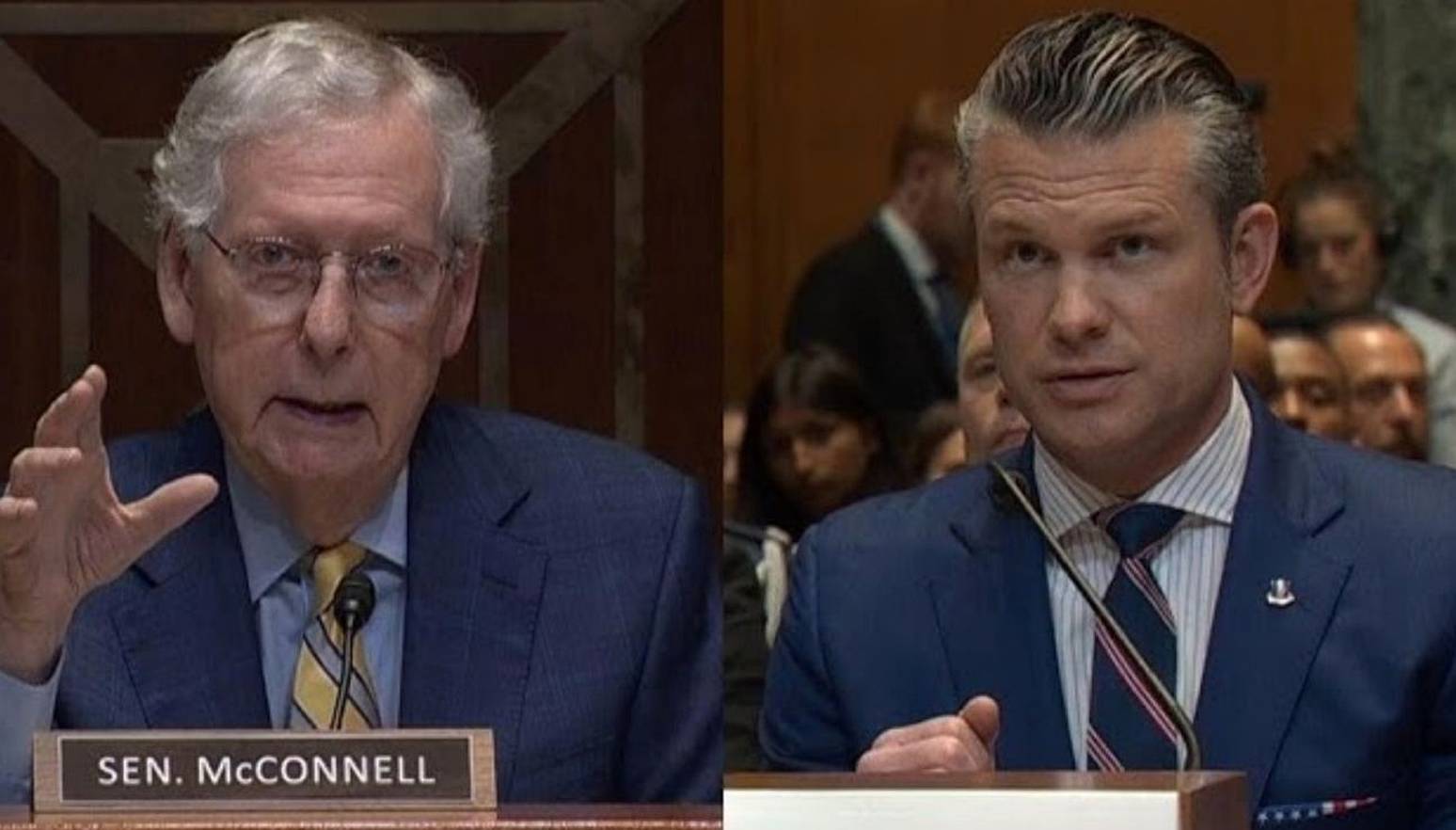
U.S. Defense Secretary Pete Hegseth went toe-to-toe with Kentucky GOP Sen. Mitch McConnell during a tense Senate Appropriations hearing Tuesday.
The back-and-forth heated up quickly after McConnell asked about the Trump administration’s plans to fund key parts of the Pentagon’s $1.5 billion budget request.
McConnell snidely accused Trump of alienating U.S. allies amid several major world conflicts.
McConnell is also on the verge of being replaced in the Senate by a pro-Trump ally.
McConnell objected to putting crucial Pentagon programs – such as the Golden Dome missile defense system, munitions, the F-35 fighter jet, and drone production – in a reconciliation bill separate from the annual defense appropriations bill.
“Political realities will not always allow a party-line budget reconciliation, and if the department’s top priorities aren’t built into annual appropriations, we’re actually taking a big risk,” McConnell said.
McConnell added, “These key lines of effort only work if we put them on solid fiscal footing.”

The Trump administration intends to finance its $1.1 trillion Pentagon budget for fiscal year 2027 with a regular appropriations request and an additional $350 billion through reconciliation, a mechanism that enables the current Republican majority to override any Democratic objections.
But McConnell said that approach is shaky given that the GOP could lose its majority in the November elections.
Other Republicans have also been skeptical about their ability to pass a third budget reconciliation package this autumn after using their second opportunity with the procedure on a narrowly tailored bill to fund immigration enforcement.
House appropriators highlighted similar worries about the structure of the Pentagon budget earlier Tuesday when Hegseth sat for several hours, testifying before the members.
McConnell also slammed President Trump for alienating longstanding U.S. friends, including for NATO and protecting Ukraine.
Trump earlier this month declared he would recall 5,000 U.S. troops from Germany and promised further measures in an ongoing disagreement with German Chancellor Friedrich Merz.
The president has repeatedly scolded U.S. partners for failing to join the fight in Iran or help reopen the Strait of Hormuz, labeling the countries “cowards” and hinting at threats to take Washington out of the NATO military alliance.
Strained relationships with U.S. partners and allies “only serves our adversaries’ interests and limits our capacity and deterrent power globally,” McConnell told Hegseth.
“I want to hear about the future of capacity building with committed allies and partners,” he added.
McConnell has been a major advocate for the $400 million Congress set aside for Ukraine at the start of the year, calling out the Pentagon for withholding the funds in an April 28 editorial.
“I want to underscore this is not charity. When our partners are capable, deterrence is stronger, and the risk to our own service members is lower,” McConnell said Tuesday.
“Wars in Ukraine and the Middle East clearly show we that have things to learn from our friends.”
WATCH:
The top three Republican candidates running to replace McConnell took the stage last month at the Henry Clay event center in downtown Louisville for the first Republican primary debate.
McConnell, a Republican who has represented Kentucky in the U.S. Senate since 1985, announced earlier this year that he won’t seek reelection in 2026 after more than 40 years in office, creating the first open Senate seat in the state in years.
Rep. Andy Barr, former Kentucky Attorney General Daniel Cameron and businessman Nate Morris are facing off in the Republican primary, which is among this year’s most competitive.
The GOP hopefuls all support President Donald Trump, hoping to land his endorsement in a state that Trump overwhelmingly carried in the past three presidential elections.
The debate offered voters an opportunity to hear the candidates discuss their positions on key issues and outline their priorities as the Republican primary campaign ramps up.