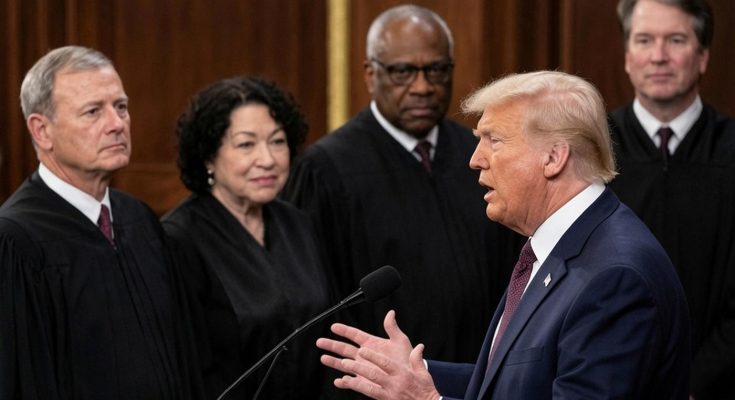
The Trump administration’s emergency appeal was granted by the justices 6-3, halting a lower court’s order to release the funds that had previously been set aside.
A White House Office of Management and Budget spokesperson said, “This is a huge win for restoring the President’s power to carry out his policies. Left-wing groups can no longer take over the president’s agenda.”
According to the majority of justices, “The harms to the Executive’s conduct of foreign affairs appear to outweigh the potential harm faced by respondents.”
These include the Global Health Council, the Center for Victims of Torture, the Journalism Development Network, and the AIDS Vaccine Advocacy Coalition.
The Supreme Court’s ruling did not address the larger question of whether President Trump has the authority to “impound” funds that Congress has approved on his own.
Trump recently announced that he intends to revoke over $4 billion in foreign aid to House Speaker Mike Johnson (R-La.).
This included $521 million in State Department contributions to international organizations, $3.2 billion in U.S. Agency for International Development (USAID) programs, and $322 million from the joint USAID–State Department Democracy Fund.
Known as a “pocket rescission,” the request was submitted to Congress so near the fiscal year’s end on September 30 that it would take effect regardless of what Congress did.
This is the first time a president has taken this action in nearly 50 years.
The disputed funding had been intended for foreign governments and nonprofit groups that are currently suing the Trump administration.
Earlier this month, Biden-appointed U.S. District Judge Amit Mehta Ali stated that the administration could not retain the funds unless Congress approved the plan to cancel them.
Ali wrote, “So far, Congress has not responded to the President’s proposal to rescind the funds.” “And the [Impoundment Control Act] makes it clear that it is congressional action, not the President sending a special message, that ends the previous appropriations.”
According to the nonprofit organizations opposing the Trump administration’s funding freeze, the pocket rescission violated federal law and jeopardized crucial, life-saving programs overseas.
Ketanji Brown Jackson, Sonia Sotomayor, and Elena Kagan all disapproved of Friday’s majority decision.
The Supreme Court agreed earlier this week to hear a case on Monday that will determine whether President Donald Trump has the authority to dismiss Federal Trade Commission employees without reason.
This case may alter the definition of presidential authority and the autonomy of federal agencies.
In a brief ruling, the justices stated that Trump could dismiss FTC Commissioner Rebecca Kelly Slaughter while the case is pending.
Until the court renders a decision, scheduled for December, the stay permitting her to leave will remain in effect.
The case asks whether the court’s 1935 ruling to uphold the protections afforded to FTC commissioners should be overturned and whether laws that prevent them from being fired violate the separation of powers.
Additionally, it will investigate whether lower federal courts have the authority to halt removals, as they did in the case of Trump’s firing of Democratic appointees.
On the left side of the high court, Justices Elena Kagan, Sonia Sotomayor, and Ketanji Brown Jackson dissented.
“He can now fire any member he wants, for any reason or no reason at all,” the majority wrote, despite Congress’s stated opposition.
Liberal Justice Kagan wrote that the order essentially gives the president “full control” over independent agencies that Congress wished to keep out of politics.
They also wrote, “And he may do this to end the agencies’ independence and bipartisanship.”