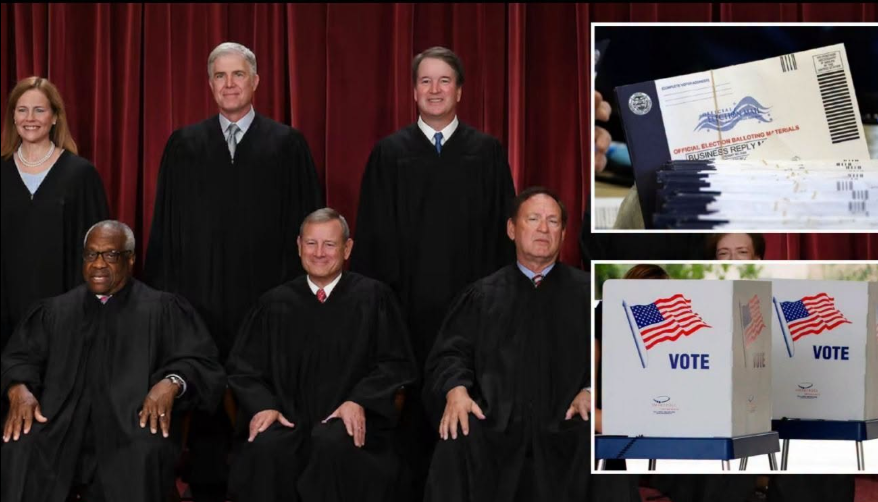
Alabama received approval from the U.S. Supreme Court on Monday to move forward with a redistricting effort that could strengthen Republican prospects in two congressional districts currently represented by Democrats.
In a 6-3 decision, the justices vacated a lower court order that had required Alabama’s congressional map to contain two majority-Black voting districts.
Democrats are already unveiling an illegal plan to stop Republicans ahead of the midterms.
Those districts are currently represented by Reps. Terri Sewell and Shomari Figures, both Democrats.
The ruling follows the Supreme Court’s recent decision in Louisiana v. Callais, which limited the use of race in congressional redistricting and struck down Louisiana’s map as an unconstitutional racial gerrymander.
Not surprisingly, left-wing Justices Sonia Sotomayor, Elena Kagan, and Ketanji Brown Jackson dissented in the Alabama ruling, multiple reports noted.
The Supreme Court directed a lower court to reconsider the Alabama case in light of its recent ruling in the Louisiana case limiting the use of the Voting Rights Act to create minority-majority congressional districts.
Republican Gov. Kay Ivey said last week that the state was “ready to quickly act” if the courts issued decisions favorable to new redistricting efforts.
State officials plan to revert to congressional district maps approved by the Legislature in 2023, along with state Senate district lines adopted in 2021.
Alabama’s May 19 primary election is expected to proceed as scheduled, though a recently enacted law gives Ivey the authority to call special elections after the primary in any districts affected by redistricting changes.
Alabama is among several states moving to redraw congressional boundaries ahead of the November midterm elections.
Republicans have so far gained momentum in the broader nationwide redistricting fight, with the GOP potentially positioned to pick up additional House seats through new district maps approved or under consideration in Texas, Missouri, North Carolina, Ohio, Florida, and Tennessee.
Last week, the Supreme Court allowed its recent landmark ruling striking down Louisiana’s congressional map to take effect immediately, prompting a sharp exchange between two justices.
Voters who initially challenged the map had asked the justices to accelerate the typical 32-day period between a ruling and its formal transmission to a lower court, a request the Supreme Court ultimately granted.
They wrote that “time is … of the essence” with elections fast approaching, and said the dispute should be returned to a lower court so it can “oversee an orderly process” to revise Louisiana’s congressional maps.
The high court approved the request, stating that the typical 32-day wait period is “subject to adjustment” by the justices.
That led the court’s DEI appointee, Ketanji Brown Jackson, to vehemently dissent, calling the 8-1 ruling “unwarranted and unwise.”
Jackson said the court should “stay on the sidelines” to “avoid the appearance of partiality,” pointing to the court’s traditional reluctance to make changes right before an election.
“And just like that, those principles give way to power,” she wrote, failing to noted that in this case, Louisiana’s current congressional maps have been ruled unconstitutional and therefore cannot be sustained.
Justice Samuel Alito, who authored the majority opinion in the Callais case, strongly pushed back in a concurrence that was joined by fellow conservative Justices Clarence Thomas and Neil Gorsuch.
Alito described Jackson’s concerns about potential bias as “baseless and insulting.” He argued that allowing Louisiana’s old maps to remain in effect could actually create an appearance of partiality by “running out the clock.”
Additionally, he stated that her suggestion that the court was abandoning its principles was “groundless and utterly irresponsible.”
“What principle has the Court violated?” he wrote. “The principle that Rule 45.3’s 32-day default period should never be shortened even when there is good reason to do so? The principle that we should never take any action that might unjustifiably be criticized as partisan?”
Alito argued that Jackson essentially advocated for Louisiana to use a congressional map that the Supreme Court has ruled unconstitutional.