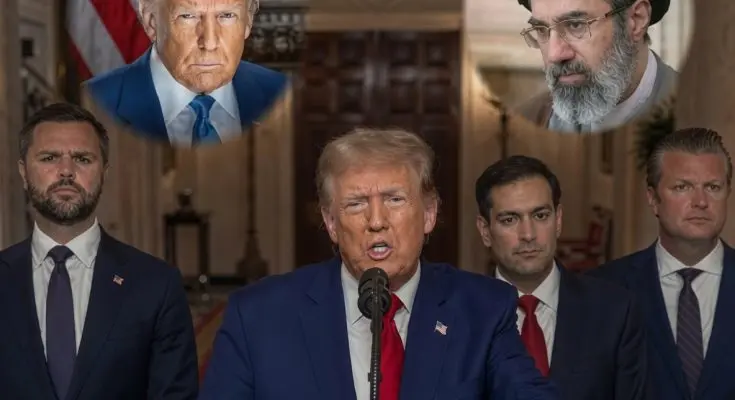
Israel and Iran traded direct strikes in June 2025, sparking fears of a catastrophic wider war and forcing Washington to weigh military intervention.
Tensions across the Middle East reached a dangerous new level in June 2025 as Israel and Iran exchanged direct attacks, raising fears that the confrontation could expand into a broader regional conflict.
Iran’s Revolutionary Guards said on June 13 that they had launched attacks against dozens of targets inside Israel, describing the operation as retaliation for Israel’s extensive strikes against Iranian nuclear, military and security facilities. The exchange marked a dramatic escalation between the two longtime adversaries. Israel had begun its offensive by targeting Iranian nuclear facilities, missile production sites and senior military figures. Israeli officials said the campaign was intended to prevent Iran from advancing toward a nuclear weapon.
Iran, which has consistently maintained that its nuclear program is peaceful, responded with missile and other attacks against Israel. The rapidly developing conflict created immediate concerns about the possibility of additional countries and armed groups becoming involved. Iran maintains relationships with regional militant organizations, while Israel has faced threats from multiple fronts, including Lebanon and Syria. Any expansion of the fighting could therefore have consequences well beyond the borders of Israel and Iran.
Regional Implications and Market Impact
The direct exchange between Israel and Iran came against an already fragile regional backdrop. The possibility of attacks on American forces, Gulf states, shipping routes and other regional targets added another layer of uncertainty. Energy markets also reacted to the escalation. Gulf stock markets fell as investors assessed the potential impact of the conflict on regional stability and energy exports.
For Israel, the immediate challenge was defending its population while determining how far the confrontation with Iran might go. For Iran, the response carried its own risks, particularly if attacks on Israel triggered deeper U.S. involvement. The United States faced a difficult strategic choice. President Donald Trump had continued to emphasize diplomacy with Tehran, but the escalation placed increasing pressure on Washington to respond to developments involving Israel and Iran.
Reuters reported that the Trump administration had been preparing for the possibility of an Israeli strike while weighing whether and how directly the United States should become involved. At the center of the confrontation was Iran’s nuclear program. Before the Israeli attacks, the International Atomic Energy Agency had raised concerns about Iran’s growing stockpile of enriched uranium, while also saying it had no credible indication of an active, coordinated nuclear weapons program.
Nuclear Program at Center of Conflict
Israel argued that military action was necessary because it believed Iran was moving rapidly toward the capability to produce a nuclear weapon. Iran rejected that characterization and maintained that its nuclear activities were intended for peaceful purposes. The U.S. decision to strike Iranian nuclear facilities later in June represented a major escalation. Trump said the American operation had targeted key nuclear sites, including the heavily fortified Fordow facility.
The central question is whether the fighting will remain limited or develop into a prolonged regional conflict. Every additional missile launch, airstrike or attack on military personnel carries the potential to widen the confrontation. Diplomatic efforts could still create a path toward de-escalation, but the rapid sequence of military actions has made that challenge considerably more difficult. The Israel-Iran conflict demonstrated how quickly tensions in the Middle East can move from indirect confrontation to direct military exchanges.
With nuclear concerns, regional alliances and American interests all involved, the consequences of the next decisions could extend far beyond Israel and Iran.